Ocean Strategies is a public affairs firm specializing in seafood, fisheries and marine resources.
This report provides timely policy and industry updates for those connecting sectors across the seafood supply chain to aquaculture policy development. Sign up here.
Included In The Report
- Fishing For Good: The Expanding Policy Landscape of American Seafood
- Spotlights Coast to Coast
- Washington
- Alaska
- California
- New England
- Mid-Atlantic
- Gulf of America
- Great Lakes
- News Thread
- Staff Picks: What We’re Taking In
- Events
2026 Policy Outlook
There’s a phrase fish people say maybe too often: If you’re not at the table, you’re on the menu. They’re not wrong. But after decades of fighting for a seat, our place is set. The next few decades should be about building the table we want to be at. That’s why this report is written a little differently than our usual fare. It highlights emerging opportunities for fisheries to be part of a bigger story, the policy entry points, and how they fortify long-held values around sustainable seafood.
U.S. fisheries advocacy has long operated inside the familiar world of MSA, import/export rules, and NOAA/NMFS budgets. These are and will always be our pillars. But in 2025, it’s clear that many forces shaping working waterfronts and long-term fisheries viability come from outside fisheries law: food security programs, trade policy, infrastructure investment, nationwide shipbuilding, public health, marine energy development, and climate-forward ocean planning. These are some of the avenues we’ve featured below, offering a framework for considering new narratives.
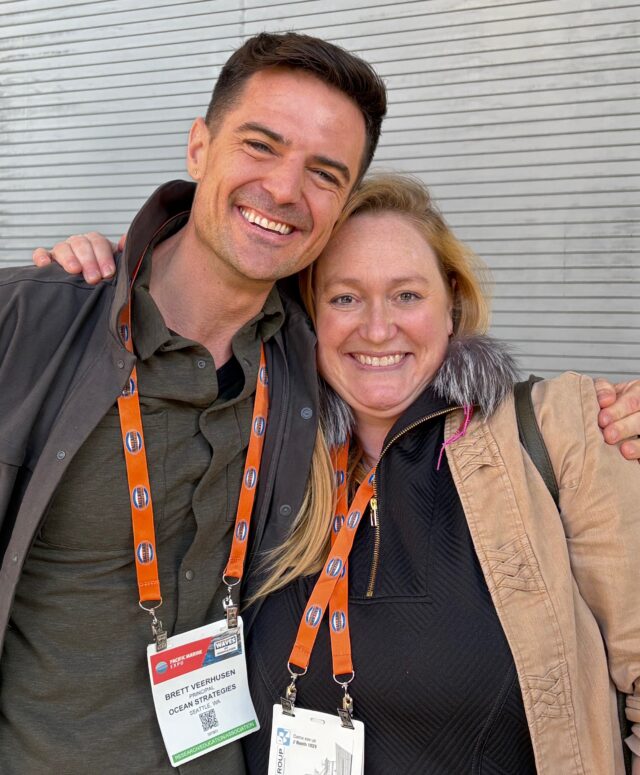
Mainstream American seafood businesses have an opportunity to look outside our lane for natural allies and effective new platforms. Seafood intersects with major national priorities: nutrition, economic resilience, climate, and community identity. Industry needs to show up where seafood has rarely been invited.
— If you want to read how seafood is beginning to take a long over-due seat at bigger tables, Brett’s recent Principal’s Report walks through how the industry showed up at One Ocean Week and Pacific Marine Expo — and what those moments signal for the future. —
Seafood sustainability can’t be secured by fisheries law alone. Nor can we secure strong fisheries law without growing allies and audiences. Both will come from positioning seafood as a genuine solution to America’s food, health, climate, and economic resilience goals — a value proposition that benefits fishing communities and the country as a whole.
What follows is a roadmap of where industry can engage and what policy actions to watch. In each section of this report, we’re thinking about:
- Seafood’s opportunity to define roles in broader arenas,
- Current policy outlets for those roles, and
- The sustainability value within that connection.
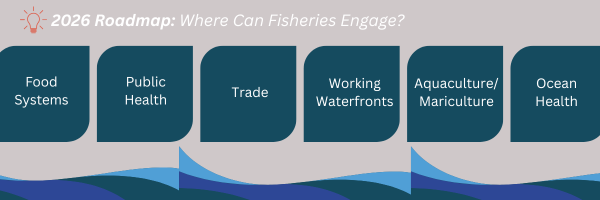
Seafood & Food Systems
The Opportunity: Seafood has a natural place in food and agriculture frameworks. Billions in federal nutrition and procurement funding flow through USDA programs, yet seafood often remains an afterthought. Significant progress has been made to change that, but more is needed to ensure seafood is visible wherever America’s food system is shaped.
Seafood offers food policy leaders a climate-smart, nutrient-dense protein that improves meal quality and reduces long-term healthcare costs. It already anchors food security in many coastal communities — but U.S. programs that shape national food access rarely include it. To matter in food systems, seafood must be explicitly named in the policies that govern them.
The Policy Approach: Farm Bill 2024–26 and Adjacent Programs
- Farm Bill Nutrition & Research Titles (SNAP, WIC, school meals, processing, R&D, Sea Grant) — elevating seafood across where food access and innovation are funded.
- USDA procurement for seafood in federal feeding programs (WIC, SNAP, school meals, Tribal distribution).
- USDA Seafood Liaison to ensure seafood is included in food and agriculture decisions.
- Modernization grants for seafood processing and cold storage.
- Regional food hubs/local procurement that place seafood alongside produce and livestock.
The Sustainability Message: Sustainable food systems start close to home, and seafood is a leader in sustainable food production. With 100,000 miles of U.S. coastline and thousands of fishing communities, fish-forward American food policy can support local food supply, motivate stewardship of wild ecosystems, and bolster climate-friendly protein consumption.
Seafood & Public Health
The Opportunity: Seafood sits at the heart of national nutrition and disease-prevention goals. Health policy links seafood to universal concerns: wellness, longevity, maternal and brain health, and healthcare cost reduction. By engaging in health policy, the sector gains public awareness, increased consumption, and institutional procurement.
As chronic disease and healthcare costs rise, the science supporting seafood has never been stronger — yet federal health policy still underutilizes it.
The Policy Approach: 2025–2030 Dietary Guidelines for Americans and FDA Programs
- Strong seafood emphasis in the Dietary Guidelines and aligned campaigns.
- Food-as-Medicine reforms (Medicare, Medicaid, VA, Tribal health) that treat seafood as preventive care.
- Increased nutrition and omega-3 research on brain, maternal, and aging health.
The Sustainability Message: Seafood is preventive healthcare. Higher consumption strengthens domestic markets and reinvestment in stewardship.
Seafood & Trade
The Opportunity: Trade determines dock prices, processor margins, and consumer costs. When imports spike or tariffs change, fishermen feel it immediately. Fisheries advocates bring real-world perspective to trade policy; trade leaders benefit from understanding impacts on rural economies and U.S. food security.
Misapplied tariffs, product dumping, and IUU imports undercut American producers. Smart trade policy stabilizes markets and rewards sustainable harvest.
The Policy Approach: Monitor Tariffs & Import Oversight
- Anti-dumping enforcement for low-priced imports (shrimp, crab, whitefish).
- Potential Seafood Import Monitoring Program updates and improvements being considered in 2026.
- Tariff incentives or credits to level the playing field for domestic harvest and processing.
- FISH Act targeting IUU fishing and upholding U.S. harvest and labor standards.
The Sustainability Message: Fair trade protects working fleets, processors, and coastal jobs — reinforcing the value of sustainable U.S. seafood.
Seafood & Working Waterfronts
The Opportunity: Ports, processors, housing, and maritime trades are essential food infrastructure. Working waterfronts are the physical backbone of coastal economies and the blue economy. Without docks, tradespeople, cold storage, and distribution, sustainable management means little.
Engaging in infrastructure policy ensures fishing remains possible — while coastal planners gain an economic partner rooted in place.
The Policy Approach: Working Waterfronts Act, IIJA/IRA, and Related Legislation
- IIJA/IRA coastal and port funding for maritime upgrades.
- Vessel modernization/hybrid engine incentives to improve efficiency.
- Maritime workforce programs to replenish aging fleets.
- Coastal broadband and subsea fiber to support traceability, safety, and operations.
The Sustainability Message: Stable port economies and cooperative development enable community resilience and long-term stewardship.
Seafood & Aquaculture/Mariculture
The Opportunity: Done right, domestic aquaculture can strengthen — not threaten — wild fisheries. Wild harvest is the backbone of U.S. seafood. Aquaculture, when responsibly developed, provides additional capacity, year-round supply, and workforce stability. The two sectors meet at the waterfront and the market; together, they can build a stronger seafood economy.
Fishermen bring vital expertise on ecosystems and siting. Aquaculture advocates bring scaling potential and year-round opportunity. Collaboration builds legitimacy and better outcomes for both.
The Policy Approach: Responsible Development Guidelines
- Advance MARA or successor legislation as a joint infrastructure strategy with safeguards, streamlined permitting, and community engagement.
- Support kelp, shellfish, and IMTA pilots that expand supply with low impact.
- Fund joint marketing and research to build a unified American seafood brand.
- Promote domestic seafood as import substitution to improve reliability.
- Support mixed-use waterfronts serving both harvesters and growers.
The Sustainability Message: Wild is foundational; aquaculture is growth. Together, they build food security and resilient waterfronts.
Seafood & Ocean Health
The Opportunity: Stewardship is an economic strategy. Biodiversity, habitat restoration, and bycatch innovation are not separate from business — they determine future harvests. A thriving ecosystem produces sustainable yields. Conservation groups gain practicality through collaboration, and fishing communities gain long-term stability.
Conservation isn’t the opposite of fishing. Conservation is how fishing continues.
The Policy Approach: NOAA Funding & Ocean Science
- Expand NOAA Habitat Restoration and resilience grants.
- Scale Electronic Monitoring modernization for cost-effective data.
- Fund bycatch reduction and selective gear innovation.
- Tie habitat funding to measurable fish productivity outcomes.
- Pursue collaborative ESA mitigation that supports recovery and access.
- Explore a Bycatch Innovation Fund to accelerate new solutions.
The Sustainability Message: Stewardship is asset protection — healthy oceans secure future harvests.
2026 Outlook: From Stakeholders to System Leaders
This is the year to build partnerships with nutrition coalitions, health institutions, aquaculture developers, climate investors, rural housing councils, food system philanthropies, maritime training programs, coastal planners, and others.
2026 invites the industry and its existing allies to:
- Develop new advocacy arenas and build new allies.
- Expand the policy map beyond fisheries law.
- Position seafood as food, health, livelihood, climate resilience, and cultural identity.
- Define sustainability squarely and appropriately as business logic.
This is the turning point — when seafood stops being defined only by management and becomes recognized as a strategic American asset.
Washington
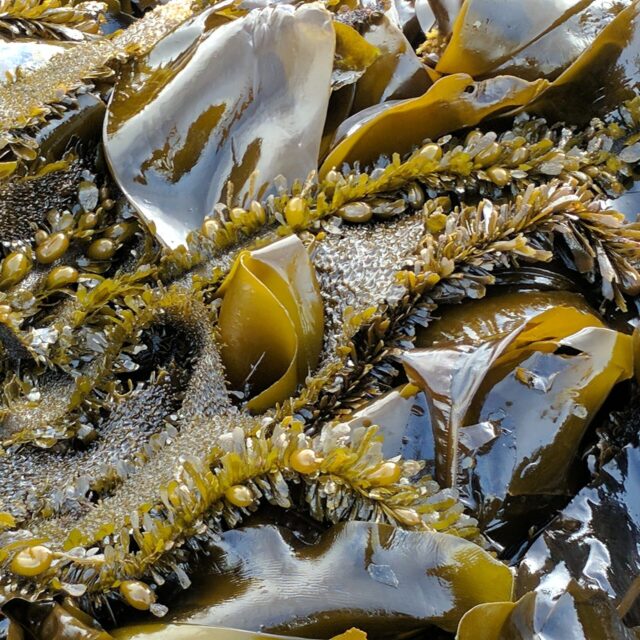
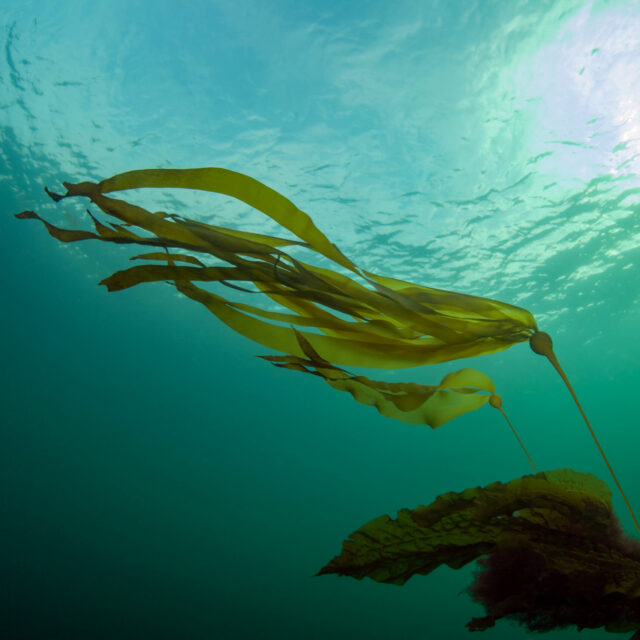
Dive into the art and science of Washington’s Salish Sea with artists Josie Iselin and Betsy Peabody, whose exhibition Kelp! Reverberations transforms SJIMA’s Atrium Gallery into an immersive underwater experience.
The new Discover West Coast Seafood website, collaboratively created by California, Oregon and Washington Sea Grant programs, combines practical tools and regional knowledge to showcase the region’s marine bounty. “This resource is a one-stop shop for information about species, gear and the people who harvest it,” says Washington Sea Grant Fisheries Specialist Jenna Keeton.
Pacific Northwest colleagues and friends – don’t miss our most recent WA Aqua Bites publication where we provide industry news, views, and information relevant to shellfish and seaweed aquaculture in Washington State. Sign up here to receive it directly.
Alaska
Oceanography On Deck, a new collaborative project brings together Alaska Bering Sea Crabbers, AMCC, and Ocean Data Network. Funded by the North Pacific Research Board, this project aims to collect continuous temperature data in the Bering Sea from fishing vessels in order to address the pressing data gaps in the Bering Sea ecosystem.
The Alaska Sea Grant Oyster Farming Operations Workshop recently gave six farmers in the early stages of their operations the opportunity to interact with some of the most experienced mariculturists in the state.
GreenWave has created a new Kelp Nursery Operations Manual that brings together years of hands-on experience, tested methods, and practical tools to help operators produce stronger seed and run more resilient nurseries. Developed with support from Alaska Sea Grant and the Alaska Mariculture Research & Training Center, the manual offers step-by-step guidance for every stage of nursery operations, from sorus collection to contamination management
This summer the Yukon River Drainage Fisheries Association (YRDFA) revived its Biological Fisheries Technician Training Camp, bringing seven participants from across Alaska to Eagle for 10 days of hands-on learning.
California
With a new cookbook out in time for the holidays and rumors of Hope in the Water season 2 airing this Spring, we would be remiss not to mention our friends over at Fed by Blue.
An opinion piece on the economic opportunity of the blue economy “investing in a resilient and sustainable blue economy offers immense environmental, social, and financial returns”.
New England
Our friends at New York Sea Grant recently created a few NEW materials related to seaweed food safety! 🌿 Download your copy today.
Women break down barriers in New Hampshire’s fisheries and aquaculture industries 45 minute documentary by New Hampshire Sea Grant – watch it on Vermont Public.
The recent insights of lobstermen provide an invaluable understanding of changing dynamics as fishery management practices struggle to keep up with warming waters.
The Gulf of Maine Research Institute sits down with John Williamson, longtime commercial fisherman and Managing Director of the Marine Resource Education Program (MREP), about how fishermen are adapting to rapid ecological and economic changes in the Gulf of Maine in Sea State: Adapting Fisheries & Seafood a new YouTube video interview released this week.
Mid-Atlantic
NOAA’s Northeast Fisheries Science Center is preparing its annual State of the Ecosystem reports for the Mid-Atlantic and New England Fishery Management Councils. The Center is looking for industry input for the 2025 Highlights section, with a focus on unusual or unexpected conditions observed during the 2025 fishing season. Be sure to weigh in by January 9th.
East Coast fishery managers pulled back last week from ordering another round of catch restrictions on struggling Atlantic striped bass amidst a shred of hopeful news about harvest pressure and a warning from commercial fishermen that their economic survival is at stake.
Gulf of Mexico
While claiming federal “red tape” stalls industry growth, Mississippi Gulf Coast oyster growers are already showing what that future could look like in this article and 2 minute YouTube video.
Great Lakes
We love the Gordon Lightfoot reference but also the recent regional celebration and homage to the Great Lakes fisheries heritage from Michigan Sea Grant. “Fisheries serve as a gauge of resource sustainability and quality of life for communities around the state.”
- This USA Today article is titled How America’s fisheries rebounded from collapse and overregulation yet there is obviously a lot more to be done.
- Regulators voted last week to extend a shutdown preventing New England fishermen from catching shrimp, a historic industry that has recently fallen victim to warming oceans.
- California Chinook salmon are a study of survival in changing climate reports National Fisherman.
Read
It’s no secret, we’re big fans of The Quality Line. The Hidden Toll of the Sea: Unexpected Costs for Small‑Boat Fishermen and What Farming Gets That Fishing Doesn’t published in November includes good storytelling with some of the specific solutions (and happy endings) that we outlined in our main analysis above.
Did you miss NOAA Fisheries’ Seafood Tips from the People Bringing You America’s Seafood featuring Thanksgiving highlights of America’s seafood suppliers from coast to coast? We’re still grateful for the highlight of our friends and colleagues.
Watch
A new drop in the Tomorrow’s Catch: Securing Our Future Fisheries film series follows the story of a partnership between T3 Alaska, the University of Alaska Southeast Applied Fisheries Program, Alaska Blue Economy Center (ABEC) andPrince William Sound College. Together, they are creating hands-on learning experiences that reach far beyond the classroom.
Last Minute Gifting
- Fishy Gift Guide from Fish Forward
- AMCC’s Alaska Young Fishermen’s Almanac vol. 3
- Stocking stuffers from Maine
- Gogo sea kelp napkin rings from St. Simons Island, Georgia
Cook
Penn Cove Shellfish here in Washington State offers a new Around the Cove newsletter to inform our Whidbey Island neighbors of their latest. The first edition included a Mussels in a creamy tomato chorizo sauce recipe that looks absolutely mouth-watering. Cheers to finding a proper recipe that matches the upcoming holiday magic!
- January 12-16, 2026; Greater Atlantic Fisheries Science & Management Workshop hosted by Marine Resource Education Program; Falmouth, Massachusetts
- January 20-22; Alaska Young Fishermen’s Summit; Juneau, Alaska
- January 28, 11am PT; Puget Sound Listening Session hosted by Blue Convergence Fund. Register here.
- February 16-19; Aquaculture America; Las Vegas, Nevada
- February 23-27; North Pacific Fisheries Science & Management Workshop hosted by Marine Resource Education Program; Juneau, Alaska
- March 22-26, 2026; National Shellfisheries Association 118th Annual Meeting; Portland, Oregon
- March 10-12; 2026 Mariculture Conference of Alaska; Anchorage, Alaska
Here is a list of links to our most recent policy reports. You are always able to find them on our Ocean Pulse Blog. If you’d like to receive them directly, just sign up here.