Ocean Strategies is a public affairs firm specializing in seafood, fisheries and marine resources.
Sign up here to receive our seasonal policy reports.
Seafood Has Momentum in Washington. The Industry Needs a Plan.
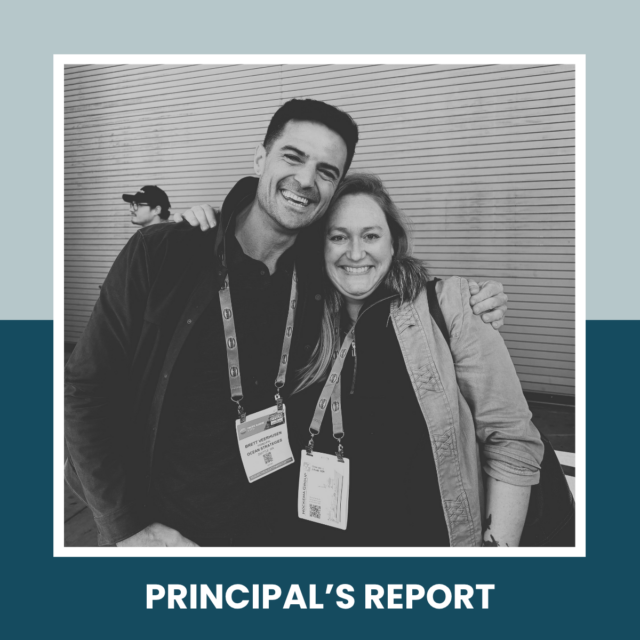
By Brett Veerhusen, CEO, Ocean Strategies
Across recent conversations in Washington, D.C. — from fisheries meetings to aquaculture briefings and agency discussions — one thing has become clear:
Seafood is no longer being discussed solely as a fisheries issue. It is increasingly being viewed through the lens of infrastructure, domestic production, workforce development, food security, freight, and economic resilience.
That creates a real opportunity for the seafood industry, but only if we engage in policy work differently than in earlier years.
In order to do that, seafood also needs to tackle one of its bigger strategic challenges: the industry still lacks a clear long-term vision for where it wants to go by 2030, 2040, or 2050. If our political opportunities are expanding, we need to know what horizons we’re navigating toward.
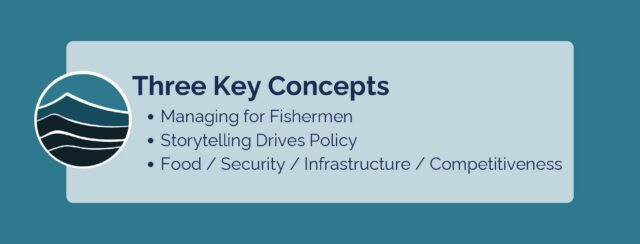
One theme came up repeatedly in different ways: for decades, fisheries policy focused primarily on managing fish. Washington is starting to ask whether we are also managing for the fishermen.
That’s a major shift.
Not away from conservation or science-based management, but toward recognizing that sustainable fisheries also require economically viable fishing businesses, functioning infrastructure, processors, crews, and pathways for the next generation.
From my perspective, one thing was also notably absent from recent conversations in D.C.: I am not hearing serious momentum around a full Magnuson-Stevens reauthorization.
What I am hearing instead is a strong focus on implementation — how councils interpret and apply the current law, how appointments are made, and whether councils truly reflect broad sectoral representation across the seafood industry.
That matters because the seafood industry does not have infinite political capital, time, or organizational capacity. We need to be smart about where we focus energy, and the responsible application and funding of MSA is as important as the law itself.
Right now, that likely means prioritizing implementation, storytelling, coalition building, infrastructure, competitiveness, and visible real-world wins over getting consumed by massive legislative fights that may not move the needle operationally or ecologically in the near term.
The USDA Office of Seafood is part of that broader shift. Seafood is finally beginning to be viewed more like agriculture: a domestic production sector tied to financing, trade, infrastructure, and rural economies. A strategic asset, not a rural accessory.
Importantly, this shift is not just happening inside the Administration. Congress is moving too.
Policymakers are Connecting the Dots
Recent actions like the American Seafood Competitiveness Act, the Save Our Shrimpers Act, the FISH Act targeting illegal foreign seafood harvest, and growing seafood provisions in the Farm Bill all point toward the same larger trend: seafood is increasingly being treated as a strategic domestic industry tied to food systems, trade, and economic resilience.
None of these bills are perfect, and many still need work. But taken together, they signal something important: policymakers are increasingly trying to connect seafood to larger national priorities.
The industry should pay attention to that momentum and help shape where it goes next. Not only does it provide opportunity for growth, it offers defensive scaffolding around the fundamental science and management services the seafood industry is constantly defending.
Other industries have done this proactive work remarkably well.
The beef industry, for example, has developed coordinated long-range plans since the 1990s that align producers, processors, research, policy priorities, infrastructure, and consumer engagement around shared industry goals.
The dairy industry has built industry-wide 2050 goals around sustainability, infrastructure, production, and long-term competitiveness that align investment, research, and government partnerships.
Broadly, agriculture consistently frames itself around long-term resilience, infrastructure, productivity, and feeding future demand. That framing helps drive investment, financing, workforce development, and political support.
Seafood largely still operates issue-by-issue and crisis-by-crisis. Even in those circumstances where we’re more forward thinking, we often do so in time- or topic-constrained silos.
That is something we at Ocean Strategies have been thinking about a lot lately.
What would a real U.S. seafood competitiveness roadmap look like?
What should the industry actually be building toward over the next 10, 20, or 30 years?
More processing capacity? Better workforce pipelines? Expanded aquaculture? Stronger domestic supply chains? Seafood nutrition campaigns? Infrastructure modernization? Export competitiveness?
Probably all of the above.
Government works far more effectively when industries articulate a coherent long-term direction. Right now, seafood is gaining attention and being integrated into broader policy conversations. The challenge now is making those opportunities durable.
Storytelling Drives Policy
That means the industry also needs to evolve how it communicates — and storytelling may be one of the biggest opportunities sitting right in front of us.
Fishermen naturally speak in fisheries language. Government agencies often speak in infrastructure, workforce, and economic development language. Agriculture speaks in production, financing, and supply chain language. All of it can get bogged down in bureaucratic language.
The seafood industry needs to become fluent in each of those angles, and what they mean in the context of a working waterfront.
That doesn’t mean abandoning fishing identity or culture. It means translating seafood into terms broader audiences immediately understand.
Right now, the industry’s most effective policy tool may not be another white paper or regulatory comment letter. It may be storytelling.
One fisherman shared how replacing an engine after a maritime accident cut fuel costs nearly in half. Suddenly, an abstract conversation about rebuilding post-disaster became a clear defense for proactive financing and recapitalization..
That is exactly the kind of story the industry needs more of.
Real-world examples connect directly to the priorities our government already cares about: infrastructure, energy, domestic production, manufacturing, labor, and economic resilience.
A Gulf fisherman discussed how IUU seafood tied to cartel activity results in flooded markets with serious impacts on honest American fishermen.
Others described the growing disconnect between U.S. fishing standards and the labor and environmental conditions tied to some imported seafood. They create price points that well-managed fisheries can’t compete with.
Those stories matter because they connect directly to larger administration priorities around domestic production, supply chains, labor, manufacturing, and economic resilience.
The seafood industry should not shy away from telling those stories — especially because they help both industry leaders and policymakers do their jobs better.
Ecologically, the United States has one of the best managed fisheries systems in the world. American fishermen should say that more often, and make the case for why the U.S. should invest just as much in fishermen and working waterfronts as they do in management.
Building more pride and visibility around American seafood helps both the industry and government do their jobs better.
At the same time, the politics around imports are changing. This is no longer just a trade conversation. It increasingly intersects with labor standards, domestic manufacturing, food security, supply chains, and national competitiveness. It’s also pivotal in conversations around carbon emissions and shifting climates – in part because it’s one of the lowest carbon proteins on the planet, and also because it’s the most heavily traded food commodity in the world.
The Final Takeaway
The industry has an opportunity to lead a much bigger conversation around transparency, traceability, domestic production, and what responsible local, national and global seafood systems should actually look like.
My advice to the industry is fairly simple:
- Refuse to operate in silos.
- Learn the language of infrastructure and food systems.
- Bring government practical projects and examples.
- Invest in storytelling.
- Organize around competitiveness, not just crisis response.
Most importantly, help our government succeed.
The sectors that shape policy best are often the sectors that explain themselves best.
Right now, leaders across agencies and throughout Congress are actively trying to better understand seafood and elevate its importance. The industry should make their jobs easier by bringing solutions, ideas, and real-world examples.
The window is open right now.
The question is whether the seafood industry is prepared to act strategically enough to take advantage of it.
I’d love to hear feedback from others across the seafood sector.
💡 What opportunities are you seeing?
💡 What infrastructure, workforce, or financing projects deserve more attention?
💡 What stories best explain the real-world challenges and opportunities facing American seafood?
💡 And what does a real U.S. seafood competitiveness strategy look like by 2030, 2040, and 2050?
Ocean Strategies has been tracking many of these themes in recent fisheries policy reports and analysis. Here are our most recent, of course you are always able to find them on our Ocean Pulse Blog. If you’d like to receive them directly, just sign up here.