Ocean Strategies is a public affairs firm specializing in seafood, fisheries and marine resources.
Sign up here to receive our seasonal policy reports.
The Case for Permanence: Building a lasting future for America’s seafood communities.
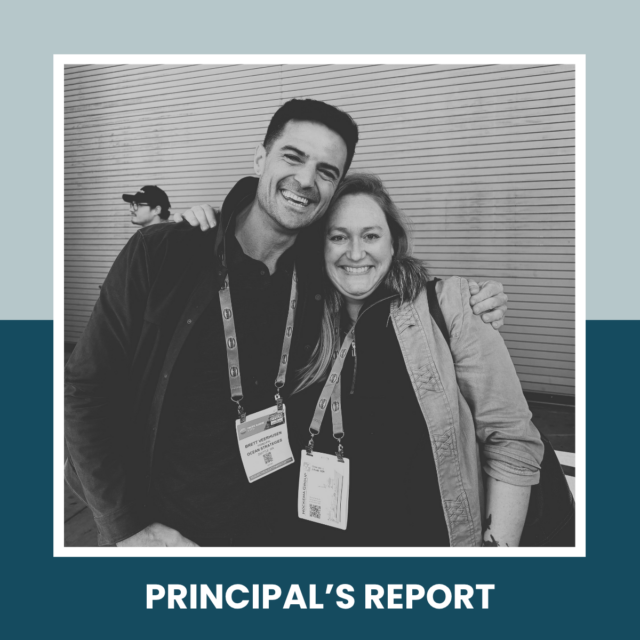
By Brett Veerhusen, Principal/CEO, Ocean Strategies
Before You Read:
- What if seafood’s biggest challenge isn’t fisheries management anymore?
- What if the industry’s greatest risk is the absence of a shared long-term vision?
- What if competitiveness is simply a means to something bigger: permanence?
- What can seafood learn from industries that have spent decades thinking beyond the next crisis?
- This report is my attempt to start that conversation.
I’m going to admit something consultants aren’t supposed to put in writing: I’ve been struggling to write this Principal’s Report.
Normally the process is fairly straightforward. You publish a report, collect feedback, identify a few common themes, and package them into recommendations. But after my last report in May, that isn’t what happened. My inbox, LinkedIn, and text were filled with thoughtful notes from fishermen, processors, shellfish growers, trade org leaders, nutrition experts, conservation leaders, seafood marketers, and people I’ve admired for years. I kept waiting for someone to burst my bubble, and point out how I’d missed the point.
 Instead, almost everyone said some version of, “Yes…and.” It’s the “and” that’s got me thinking.
Yes, seafood needs to think bigger…and don’t forget consumer demand!
Yes…and shellfish and aquaculture need to be part of the conversation!!
Yes…and what about consolidation?
Yes…but who’s going to fish twenty years from now??
At first, I thought everyone was talking about different issues. Looking back, I don’t think they were.
I thought my last Principal’s Report was about competitiveness. The more I’ve reflected on the conversations that followed, the more I think it was actually about something broader. Competitiveness was simply one symptom of a larger challenge: our industry doesn’t yet have a shared picture of where it’s trying to go.
Consumer demand matters. Infrastructure matters. Trade matters. Conservation matters. Responsible aquaculture matters. Workforce matters. Working waterfronts matter. Competitiveness matters. They’re all important, but none of them are the destination.
The word I keep coming back to is permanence.
Not permanence for one company or one fishery. Permanence for seafood communities. Permanence for working waterfronts. Permanence for the next generation of fishermen, shellfish growers, aquaculturists, processors, and seafood businesses that will inherit what we build today.
That feels like a much more meaningful goal than simply becoming “more competitive.”
The industry may not have a shared picture of where we’re trying to go, but that’s because many have been focused for decades on how to not go away.
Healthy Fish Aren’t the Finish Line
One comment has been stuck with me: Healthy fish stocks don’t automatically create healthy fishing communities. Another way it’s been said is we’ve been managing for the fish, we must also manage for the fishermen.
It’s one of those statements that seems obvious once someone says it. 
You can have healthy fish and still lose your processor. Healthy fish and no affordable waterfront. Healthy fish and no young fishermen entering the industry. Healthy fish and a downtown that slowly transforms into condos instead of businesses that support a working waterfront.
None of this is a criticism of fisheries management. Quite the opposite.
The Magnuson-Stevens Act has accomplished something remarkable over the past fifty years. It has protected an American public resource while rebuilding many fisheries that once seemed impossible to recover. American fisheries management remains one of the country’s great public policy successes.
But we’re increasingly asking fisheries management to solve problems it was never designed to solve. Markets. Infrastructure. Workforce development. Consumer demand. Housing. Community resilience. Public trust.
Those aren’t failures of fisheries management. They’re reminders that American seafood is much bigger than fisheries management alone.
A Broader Conversation Is Beginning
Earlier this Spring, I attended Seafood Harvesters of America’s Fisheries Leadership & National Policy Forum in Washington, D.C., of which Ocean Strategies was proud to sponsor.
I left encouraged.
Whether the conversation centered on infrastructure, consumer demand, trade, workforce shortages, financing, processing or the newly established USDA Office of Seafood, there was broad agreement that seafood’s future extends well beyond traditional fisheries management. That’s meaningful progress. It’s also consistent with what we’ve been writing over the past year: that seafood increasingly belongs in conversations about food systems, rural economic development, public health, manufacturing, and national resilience.
But I also left Washington with another observation.
 We’re remarkably aligned on the challenges.
I’m not convinced we’re equally aligned on the destination.
One reason may be that seafood naturally organizes itself around sectors. Commercial fishermen. Finfish aquaculture. Shellfish growers. Processors. Importers. Exporters. Regional fisheries. Large boats and small boats. Those distinctions matter, and they always will.
But when I walk a working waterfront, those lines become much blurrier.
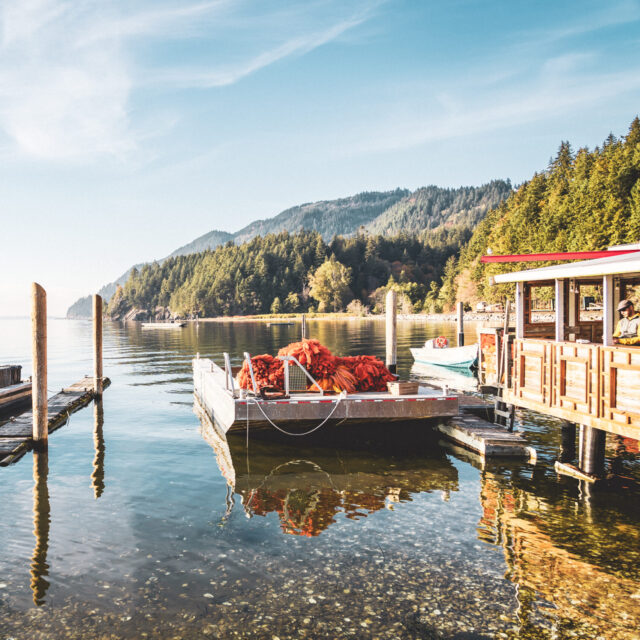
I see the same docks. The same travel lift. The same ice house. The same processor trying to keep people employed year-round. The same marine mechanic. The same welder. The same truck driver. The same workforce.
Working waterfronts don’t survive because one sector succeeds. They survive because enough sectors succeed together.
That has me wondering whether we’ve spent too much time defending sectors and not enough time strengthening places.
We’re Long on Leadership, We’re Short on Alignment
One section from my last Principal’s Report continues to stick with me, particularly when I look at it next to these latest industry conversations.
The beef and dairy industries have spent decades developing long-range strategies that bring together producers, processors, researchers, policymakers, and marketers around shared objectives. They certainly don’t have everything figured out—small farms face many of the same economic pressures as commercial fishermen—but I admire their commitment to thinking beyond the next crisis. I find myself wondering what seafood could learn from that process, not because we should copy agriculture, but because we’re trying to solve many of the same challenges. 
Seafood often feels different. We’re exceptionally good at responding to today’s problems. We’re running around like chickens with our heads cut off without a long-term plan on how to sell poultry. Whatever that analogy is, you get my drift.
We’re long on leadership.
I think we’re short on alignment.
This isn’t because seafood lacks ideas. NOAA spent years developing a National Seafood Strategy. The current administration has shifted toward reducing regulatory burdens and increasing domestic seafood production. Seafood Harvesters of America recently released a thoughtful set of policy priorities. Universities continue producing excellent research. Philanthropy continues investing in innovation. Organizations across the country are doing thoughtful work.
The challenge isn’t a shortage of ideas.
It’s that no one is responsible for weaving them together into a long-term vision that survives election cycles, agency reorganizations, or changing markets. And the stakes are higher than they might appear. Once a processor closes, once a fuel dock disappears, once a waterfront is redeveloped, once young families stop seeing opportunity in seafood, those things become extraordinarily difficult to rebuild.
One question has become impossible for me to shake.
What vehicle is the long-term future of American seafood hitched to?
It isn’t a Magnuson-Stevens Act reauthorization. Almost every seafood rep I talk to holds little to no appetite for opening it back up. And besides, are Magnuson and the regional fishery management councils the appropriate venues to address consumer demand, trade barriers, workforce shortages and seafood’s role in improving human health?
Probably not. But it’s also not the next Farm Bill, or appropriations cycle. At least, not singularly.
I probably sound like I’m pontificating, but it’s a serious question I have, and eek! I don’t have the answer.
Building a Bigger Table
 Maybe that’s the conversation we’re missing.
We often say seafood needs a seat at more tables. I agree. But I also think it’s time to build a bigger table of our own.
Imagine if organizations like Seafood Harvesters of America, Fishing Communities Coalition, the regional fishery management councils, National Fisheries Institute, Seafood Nutrition Partnership, the National Aquaculture Association, Stronger America Through Seafood, the Pacific Coast Shellfish Growers Association, the East Coast Shellfish Growers Association, Sea Pact, FMI – The Food Industry Association, the National Restaurant Association, conservation organizations, universities, philanthropy, NOAA, USDA, and others committed to one recurring conversation:
What should American seafood become by 2030? By 2040? By 2050?
Please, NOT another report that sits on a shelf. And NOT another exercise in exclusivity.
A living roadmap with diverse leaders charging ahead that know each sector and the industry at large. Leaders who don’t jump from one fancy gig to another.
A plan, a roadmap, whatever you want to call it that measures progress. Creates durable bipartisan solutions. Connects agencies. Evolves with new information. Survives administrations. Aligns policy, infrastructure, research, workforce development, consumer demand, conservation, wild capture and responsible aquaculture around a shared destination.
I don’t know who should convene that conversation.
I just think it’s time someone does.
What We Do Next
I don’t have a five-point plan to fix American seafood.
And I can confidently say at this point in my career, nobody does.
I do think there are practical places to begin: bring USDA and local leaders to our docks and farms; tell more stories about seafood’s value, not just its crises; build stronger relationships across fishing, aquaculture, processing, retail and food; and show up at the USDA Office of Seafood with a few shared priorities instead of dozens of competing ones.
One thing has become clear to me over the past few months.
Ocean Strategies isn’t just interested in explaining where seafood policy is headed. I think our role is becoming something different. We want to create more space for long-term thinking, connect people who don’t normally find themselves in the same room, challenge our own assumptions, and ask bigger questions about where American seafood should be, not simply where it is.
Because I don’t think permanence happens by accident.
I think communities choose to build it.
And maybe that’s the conversation our industry has been trying to have all along.
Ocean Strategies believes better questions lead to better shared action and policy. What resonates? What did we miss? We’d love to hear from you; reach out to us via brett@oceanstrat.com.
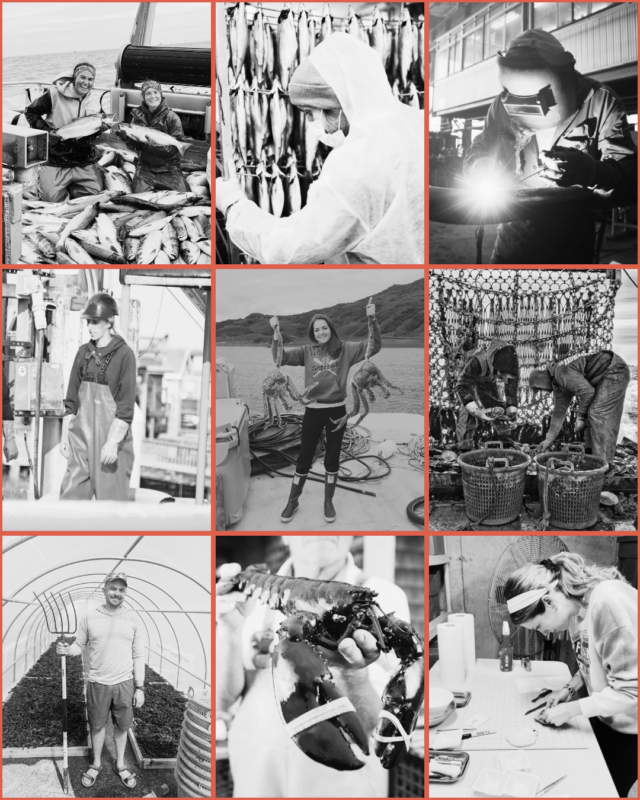
Grid photos courtesy of the following, clockwise 1-3 Shutterstock; 4 Maine Coast Fishermen’s Association; 5 Fishing Communities Coalition Member; 6 Shutterstock; 7 Puget Sound Restoration Fund; 8 Shutterstock; center, Fishing Communities Coalition Member.
Ocean Strategies has been tracking many of these themes in recent fisheries policy reports and analysis. Here are our most recent, of course you are always able to find them on our Ocean Pulse Blog. If you’d like to receive them directly, just sign up here.